
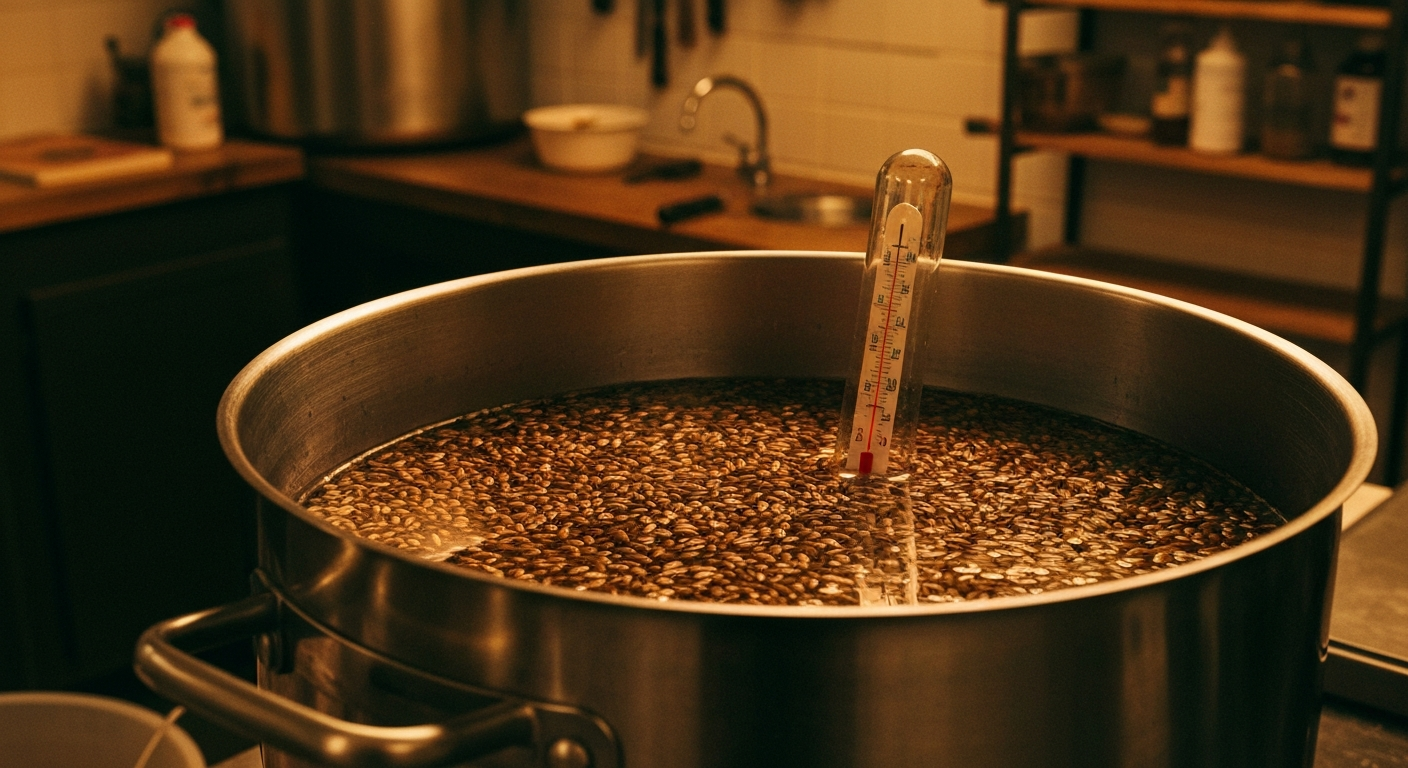
Why Moisture Content Is the Single Most Important Variable
I'm going to make a bold claim: moisture content is more important than sterilisation time, more important than inoculation technique, and more important than incubation temperature. Get your moisture content right and you can get away with being slightly sloppy on everything else. Get it wrong and nothing else matters. your bags will fail regardless of how perfect your sterile technique is.
I learned this the hard way. For my first year of making grain spawn, I was obsessed with sterilisation. I'd run 150-minute cycles, then 180 minutes, convinced that contamination was a sterilisation problem. It wasn't. My grain was too wet. I was soaking for 24 hours (as one popular guide recommended) and then barely simmering for 15 minutes. The resulting grain was at something like 58-60% moisture. far too high. Every bag was a bacterial breeding ground waiting to happen, and no amount of sterilisation time was going to fix a substrate that was fundamentally too wet.
The day I bought a £12 kitchen scale and started actually measuring my grain's moisture content was the day my contamination rate dropped from "despair" to "manageable." Within a month of dialling in my hydration protocol, it dropped further to under 5%. Same pressure cooker. Same bags. Same everything. except now my grain was at 52% moisture instead of 59%.
Why 52% Is the Magic Number
The target moisture content for rye grain spawn is 52% (wet basis). This isn't a number I invented. it comes from decades of commercial spawn production research, and it's been validated by every serious cultivator I know. But let me explain what it means and why it works.
Moisture Content Defined
At 52% moisture: 1 kg of hydrated grain contains 520g water and 480g dry matter.
Dry rye grain starts at ~12-14% moisture. To reach 52%, each kilo of dry grain needs to absorb approximately 440-460ml of water.
At 52%, the grain has absorbed enough water for the mycelium to access readily, but the kernel surface is dry to the touch and individual grains don't stick together. This "dry surface, wet interior" state is critical. The dry surface means there's no free water between kernels. free water is where bacteria thrive. The wet interior means the mycelium has the moisture it needs for growth once it penetrates the kernel.
Think of it like a sponge that's been wrung out properly. Squeeze a sponge under the tap and let go. it's saturated, dripping, useless for wiping anything. Wring it out firmly until it stops dripping but still feels damp. now it's functional. Your grain needs to be that wrung-out sponge.
What Happens Above and Below 52%
The margin of error is tighter than most people realise. Here's what I've observed at various moisture levels:
Moisture Content vs Outcome (Rye, n=200+ bags)
46-49%: Slightly dry. Colonisation 20-30% slower than optimal. Mycelium healthy but progress is visibly sluggish. Acceptable in a pinch.
50-54%: Optimal range. Fast colonisation, vigorous rhizomorphic growth, minimal bacterial competition. Target: 52%.
55-57%: Slightly wet. Colonisation speed is actually good (sometimes faster than 52%), but contamination rate doubles. Free moisture visible on some kernels. Risky.
Above 58%: Too wet. Grain clumps together, free water pools in bag corners, bacterial contamination rate exceeds 25% regardless of sterilisation time. Unworkable.
The Wet Trap
Slightly wet grain (55-57%) is deceptive because it colonises fast. Beginners often think "fast colonisation = good grain" and keep preparing grain on the wet side. Then they blame their still-air box or their liquid culture when bags go bacterial. The contamination isn't a sterile technique problem. it's a moisture problem masquerading as one.
The Squeeze Test (And Why It's Unreliable)
Every beginner guide tells you to do the squeeze test: grab a handful of soaked grain, squeeze hard, and if one or two drops of water come out, you're good. If water streams out, too wet. If nothing comes out, too dry.
I used the squeeze test for months. It's better than nothing, but it's genuinely unreliable, and here's why:
- Grip strength varies. My squeeze and your squeeze are not the same. I've watched two people test the same batch of grain and get different results because one has stronger hands.
- Grain temperature matters. Warm grain (just out of the simmer pot) expresses water more easily than cool grain. If you test hot, you'll think it's wetter than it is. If you test after it's cooled, you'll think it's drier.
- Kernel integrity. If any kernels have cracked during soaking, they'll release starchy water on squeezing that makes the grain seem wetter than the intact kernels actually are.
- Sample size. A handful is maybe 40-50 kernels. Your bag has 8,000+. You might grab a wet handful from the bottom of the strainer and think the whole batch is too wet.
The squeeze test will catch gross over-hydration (streaming water = definitely too wet) and gross under-hydration (bone-dry grain that clinks like gravel = definitely too dry). It won't distinguish between 50% and 56% moisture, and that 6% difference is the gap between a perfect batch and a contamination risk.
The Paper Towel Method (Better, Still Not Great)
This is a step up from the squeeze test. Take 10 kernels of prepared grain and place them on a folded paper towel. Press another folded paper towel on top and press down firmly with your palm for 10 seconds. Remove the top towel and examine it.
- No moisture mark: Grain is under 48%. Too dry.
- Faint damp outline around each kernel: 48-54%. In range.
- Wet spots that spread beyond the kernel outline: Above 55%. Too wet.
- Towel is visibly wet, water wicks outward: Above 58%. Way too wet.
This method is more repeatable than the squeeze test because the pressure is more consistent (palm press vs grip strength) and you're looking at a visual result rather than trying to count drops. I used this for about a year before switching to the weight-based method, and it served me well. It's accurate to within about 2-3 percentage points, which is enough to keep you in the safe zone most of the time.
Paper Towel Calibration
Use the same brand of paper towel every time. Different towels have wildly different absorbency. I use the cheap Tesco own-brand ones. they're thin enough that the moisture mark is clearly visible. Thick, quilted kitchen roll absorbs too much and makes everything look drier than it is.
The Weight-Based Method (The Gold Standard)
This is what I use now, and it's what I recommend to anyone who's serious about consistent results. You need a kitchen scale accurate to 1g (any digital scale over £10 will do) and basic arithmetic.
The Protocol
- Weigh your dry grain before soaking. Record this number. (e.g., 1,100g)
- Soak and simmer according to your hydration protocol.
- Drain the grain thoroughly. Spread on a clean surface to steam off for 15-20 minutes, stirring occasionally.
- Weigh the hydrated grain. (e.g., 1,680g)
- Calculate moisture content.
Moisture Content Formula
Example: 1,680g - 1,100g = 580g water absorbed
But dry grain already contains ~13% moisture, so:
Total water in hydrated grain = water absorbed + (dry weight × 0.13)
Example: 580g + (1,100 × 0.13) = 580 + 143 = 723g total water
Moisture content = (total water / hydrated weight) × 100
Example: (723 / 1,680) × 100 = 43.0%
Hmm, that's too dry. Need to soak longer or simmer longer.
Wait. I've deliberately shown you a calculation that results in grain that's too dry, because that's what happens when people follow the common "soak 12 hours, simmer 15 minutes" advice with UK rye. The grain doesn't absorb enough water. You need to adjust your soak time until the final moisture content hits 50-54%.
Target Weights
To simplify things, here are the target hydrated weights for common starting amounts of dry rye grain (assuming 13% starting moisture):
Quick Reference: Dry Weight to Target Hydrated Weight
1,000g dry → 1,820-1,880g hydrated (52% target: 1,848g)
1,100g dry → 2,000-2,070g hydrated (52% target: 2,033g)
2,500g dry → 4,550-4,700g hydrated (52% target: 4,620g)
5,000g dry → 9,100-9,400g hydrated (52% target: 9,240g)
If your hydrated grain weighs less than the low end, soak longer next time. If it weighs more than the high end, drain longer or reduce soak time.
I've got these numbers taped to the wall above my prep station. After a few batches, you won't need them. you'll know by feel when the grain is right. But until then, weigh everything. The scale doesn't lie, and it doesn't have variable grip strength.
Species-Specific Moisture Preferences
The 52% target is a general-purpose optimum, but different species have slightly different preferences. These are based on my observations across several hundred bags. they're not hard rules, but they're consistent enough that I adjust my hydration protocol depending on what I'm growing.
Optimal Moisture Content by Species
Pleurotus djamor (Pink Oyster): 52-55%. slightly wetter than Blue/Grey Oyster, tropical species likes moisture
Hericium erinaceus (Lion's Mane): 50-52%. prefers the drier end, very sensitive to excess moisture
Ganoderma lucidum (Reishi): 52-54%. tolerant, but slightly wetter seems to speed colonisation
Lentinula edodes (Shiitake): 48-51%. notably drier preference, excess moisture causes stalling
Psilocybe cubensis: 52-54%. standard range works perfectly, forgiving species
All values are wet-basis percentages for rye grain spawn.
The most important takeaway from this table is Lion's Mane and Shiitake. Both prefer drier grain than the standard 52%. If you're growing either of these and experiencing slow colonisation or stalling, your grain might be too wet. even if it's perfect for Oyster mushrooms. I keep separate hydration notes for "standard" and "dry-preference" species.
One Protocol, Two Variants
Rather than maintaining completely separate protocols, I use my standard hydration protocol and then adjust the steam-off time. For standard species (52%): 15-20 minutes of steaming off after draining. For dry-preference species (49-51%): 30-40 minutes of steaming off, with more frequent stirring. Same soak, same simmer. just a longer drying period.
What Goes Wrong: A Field Guide to Moisture Failures
Too Wet (Above 55%)
You'll know your grain is too wet when you load it into bags and see any of these signs:
- Grain sticks together in clumps rather than flowing freely
- Water droplets visible on the inside of the bag within hours of loading
- The bag feels heavy and dense rather than loose and shiftable
- After sterilisation, a pool of cloudy water collects in the bag's bottom corner
What happens next is predictable: bacterial contamination. Wet grain goes sour (Bacillus species), develops a foul smell within 3-5 days, and the grain turns slimy and grey. Mycelium may start colonising but gets overtaken by bacteria within the first week. The telltale sign is a sour, fermented smell when you open the bag. healthy grain spawn smells earthy and slightly sweet, like fresh mushrooms. Bacterial grain smells like a compost bin in July.
Too Dry (Below 48%)
Dry grain is less dramatic but equally frustrating:
- Grain pours like dry rice. almost no moisture feel at all
- Individual kernels feel hard and dense, not plump
- After inoculation, mycelium appears wispy, thin, and tomentose rather than vigorous and rhizomorphic
- Colonisation stalls at 60-80%, leaving patches of uncolonised grain that never get covered
Dry grain rarely contaminates because there's not enough moisture for bacteria to thrive. but the mycelium can't thrive either. You end up with bags that sit for weeks, making glacial progress, eventually becoming a waste of incubation space and patience. I'd rather lose a bag to contamination in week one than watch it limp along for four weeks before giving up.
Dialling It In: A Practical Workflow
Here's my recommendation for anyone who's been eyeballing their grain moisture and wants to get serious:
- Buy a kitchen scale. £12 from Argos, Amazon, wherever. Non-negotiable.
- Record your dry grain weight for the next three batches.
- Record your hydrated grain weight (after draining and steaming off) for those same batches.
- Calculate the moisture content using the formula above.
- Note the outcome. colonisation speed, contamination, any issues.
- Adjust your soak time up or down to hit the 50-54% window.
Three batches is enough to calibrate your specific setup. Your tap water temperature, your rye variety, your soak vessel, your simmer intensity. all of these affect how much water the grain absorbs. My protocol (detailed in The Rye Bible: Hydration) gets my grain to 52% consistently, but your conditions might need slightly different timings.
Once you've found your numbers, write them down and stick with them. Consistency is the goal. My prep sheet says: "1,100g dry rye, 18-hour soak, 20-minute simmer, 20-minute steam-off, target hydrated weight 2,033g." If the hydrated weight is more than 50g off target, I adjust the steam-off time. It takes about 30 seconds to check and saves hours of downstream problems.
The Bucket Test
If you're doing large batches and weighing the whole lot is impractical, weigh a 500g sample in a measuring jug before and after hydration. Scale up the ratio to your full batch. It's not as precise as weighing everything, but it's far better than the squeeze test, and it takes 30 seconds.