
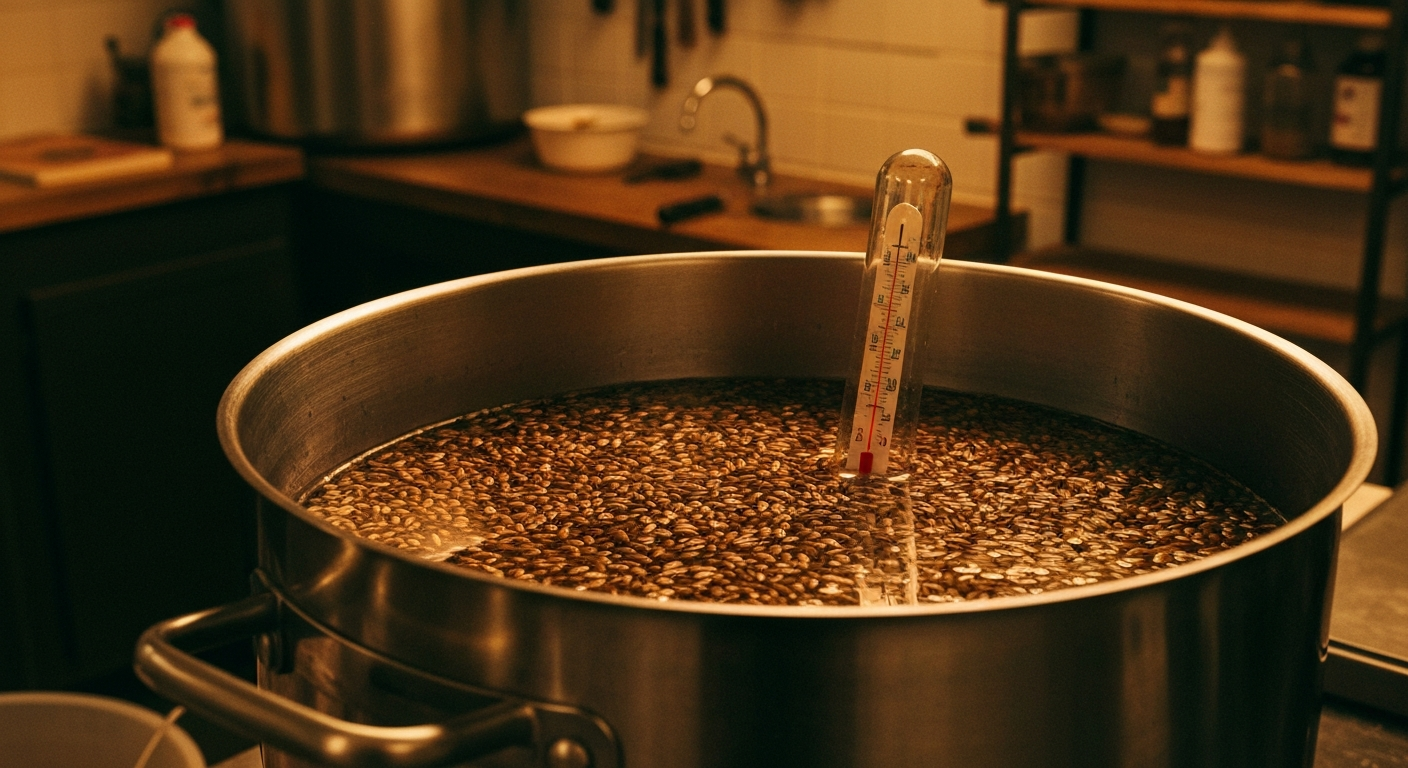
Why Hydration Is Everything
If sourcing is the foundation, hydration is the load-bearing wall. Get this wrong and nothing downstream will save you. not a perfect sterilisation cycle, not the cleanest flow hood on the market, not the most aggressive liquid culture you've ever made. I've watched people obsess over their inoculation technique while completely ignoring the fact that their grain was either bone-dry or swimming in water. The mycelium doesn't care how steady your hands are if the moisture content of the grain is wrong.
I spent the better part of six months dialling in my hydration protocol. That sounds excessive until you realise that every variable. water temperature, soak duration, grain batch, ambient temperature, even the age of the grain. shifts the outcome. What I'm sharing here is the result of over 200 individually logged bags across different seasons, grain sources, and conditions. It's not theoretical. It's what actually works.
The Hydration Equation
Optimal soak temperature: 10-15°C
Standard soak duration: 18-22 hours
Post-soak simmer: Not recommended (see below)
Bags logged for this data: 200+ over 6 months
The reason hydration matters so much is biological. Mycelium needs water to grow. it's the transport medium for nutrients, the solvent that makes enzymatic digestion possible. But it also needs gas exchange. Too much water fills the interstitial spaces between grains, creating an anaerobic environment where bacteria thrive and mycelium suffocates. Too little water and the mycelium can't metabolise the grain's starches and proteins efficiently. Colonisation slows to a crawl, stalls, or simply doesn't happen.
The difference between a bag at 48% moisture content and one at 53% is stark. At 48%, I consistently see colonisation times of 14-18 days for a standard 1.1 kg bag. At 53%, that drops to 10-13 days. At 58%, colonisation starts fast but bacterial contamination rates spike because the grain surface is too wet. There's a sweet spot, and it's narrower than most people think.
The Cold Soak Method
I use a cold soak exclusively. No simmering, no boiling, no hot water. This is a deliberate choice based on data, not laziness. though I'll admit it's also far less hassle than standing over a pot watching grain.
The Basic Protocol
Measure out your dry rye grain. 1.1 kg per bag you plan to prepare. Place it in a clean bucket or container. Add cold tap water until the grain is submerged by at least 5 cm. That margin matters because rye absorbs a surprising amount of water and will expand as it hydrates. If you only just cover the grain, the top layer will be exposed within a few hours and hydrate unevenly.
Leave the bucket in a cool location for 18-22 hours. That's it. No stirring, no temperature monitoring, no intervention. When the time's up, drain the grain thoroughly through a colander or mesh screen, spread it on a clean towel or drying rack, and let it surface-dry for 30-60 minutes before loading into bags.
Bucket Sizing
I use 25-litre food-grade buckets from a catering supplier. Each bucket comfortably holds 5.5 kg of dry grain plus enough water to cover it with room to spare. That's exactly five bags' worth. one full pressure cooker load. Label your buckets with the soak start time using a whiteboard marker on the lid. It wipes off easily and means you'll never have to guess when to drain.
Why Not Simmer?
The simmering method. bringing soaked grain to a gentle boil for 10-15 minutes. is probably the most commonly recommended approach in online guides. I used it for my first 50 or so bags before switching to cold soak. The problem with simmering is control. It's incredibly easy to overcook rye. The starches gelatinise, the kernels split, and you end up with a sticky, clumpy mess that's a bacterial playground. Even when you get the timing right, simmered grain has a narrower moisture content window than cold-soaked grain. One minute too long and you've crossed from "perfectly hydrated" to "wet and burst."
With cold soak, the grain hydrates gently and uniformly. The kernels swell without splitting. The surface remains intact, which is critical for two reasons: intact surfaces dry more consistently, and they resist bacterial colonisation better than damaged, starchy surfaces. My contamination data tells the story clearly.
Contamination Rate: Cold Soak vs Simmer
Simmer (15 min after 12h soak): 8.2% contamination (n=58)
Same grain source, same sterilisation protocol, same inoculation method.
The simmer group had more than double the contamination rate. Most of the failures were bacterial. the wet, slightly burst kernels created pockets of free moisture that bacteria exploited before mycelium could establish. Cold soak grain, properly drained and surface-dried, simply doesn't have those pockets.
Water Temperature Effects
This is where most people's eyes glaze over, but it matters. The temperature of the soak water affects two things: the rate of hydration and the microbial activity during the soak itself.
The Data
I ran a controlled test over three months, soaking identical grain at different water temperatures for 18 hours and measuring the resulting moisture content and subsequent contamination rates. The results surprised me.
Water Temperature vs Outcome (18h soak)
10°C (cool garage, winter): MC 50-52%, colonisation optimal, 2.8% contamination (n=36)
15°C (cool room): MC 52-54%, colonisation optimal, 3.5% contamination (n=38)
20°C (room temp): MC 54-57%, colonisation fast but uneven, 7.3% contamination (n=30)
25°C (warm room, summer): MC 56-60%, bacterial issues, 14.2% contamination (n=18)
MC = moisture content by wet weight. All bags sterilised identically (15 psi, 120 min).
The sweet spot is 10-15°C. Below that, the grain doesn't absorb enough water in 18 hours and you end up under-hydrated. Above 20°C, the water itself becomes a bacterial incubator. Rye releases nutrients into the soak water. you'll notice it turns cloudy and slightly foamy. and at warmer temperatures, bacteria multiply rapidly in that nutrient-rich solution. By the time you drain the grain, the bacterial load on the kernel surfaces is significantly higher, and your pressure cooker has to work harder to achieve sterility.
At 25°C, the soak water smells noticeably sour after 18 hours. That smell is lactic acid bacteria having a field day. Some growers use this deliberately (the "no-soak, no-simmer" fermentation technique), but for standard cold soak, you don't want fermentation. You want clean hydration.
Practical Temperature Control
In the UK, hitting 10-15°C is straightforward for most of the year. A garage, shed, or utility room will be in that range from October through April. In summer, it gets trickier. My garage hits 22-24°C in July and August, which pushes me into the danger zone.
My summer solution is simple: I add a few frozen water bottles to the soak bucket. Not ice cubes. they melt too fast and dilute the nutrient concentration in the water (which affects how cleanly the grain drains). Frozen 500 ml bottles, sealed, placed in the bucket alongside the grain. Two bottles in a 25-litre bucket drop the water temperature by about 5-7°C and keep it below 18°C for the duration of the soak. I pull them out before draining.
Never Use Hot Water
I've seen people recommend starting with warm or hot water to "speed up hydration." Don't. Hot water (above 30°C) gelatinises the surface starches of rye kernels almost immediately, creating a sticky exterior that clumps during draining and traps moisture unevenly. It also jump-starts bacterial growth. The 18 hours you save by soaking at 30°C will cost you three times that in contaminated bags. Be patient. Cold soak works.
Soak Duration: Finding Your Window
The standard recommendation is "soak overnight." That's uselessly vague. Overnight could be 8 hours or 14 hours depending on when you set it up and when you wake up. For rye grain, the soak duration has a measurable impact on moisture content, and therefore on everything that follows.
The Timeline
I measured moisture content at 2-hour intervals across a 30-hour soak period at 12°C. Here's what happens:
Moisture Absorption Over Time (12°C soak)
6 hours: 32% MC (rapid initial absorption)
12 hours: 44% MC (absorption slowing)
16 hours: 49% MC (approaching target)
18 hours: 51% MC (lower end of target range)
20 hours: 53% MC (centre of target range)
22 hours: 54% MC (upper end of target range)
24 hours: 55% MC (slightly over. still usable)
30 hours: 58% MC (over-hydrated. bacterial risk rises)
The absorption curve is logarithmic. The grain drinks water rapidly in the first 6-8 hours, then the rate drops off significantly. Between 16 and 22 hours, you're gaining about 1% moisture content every 2 hours. That's the window where precision matters, and it's also the window where you have the most control. A 2-hour variation in your soak time changes the MC by only 1-2 percentage points, which is well within the acceptable range.
This is why I say 18-22 hours: it gives you a 4-hour window of flexibility while staying within the 50-54% target. Set it up at 8pm, drain it between 2pm and 6pm the next day. Or set it up at 6am and drain it between midnight and 2am. The point is, you don't need to set an alarm for the exact 18-hour mark. you have breathing room.
Under-Soaking (Less Than 14 Hours)
If you drain at 12 hours, you're at roughly 44% MC. That's noticeably under-hydrated. The grain will look right. plump, swollen. but the interior moisture distribution is uneven. The outer layers of the kernel are fully hydrated while the core is still relatively dry. This creates problems during sterilisation: the outer layers over-cook while the core under-hydrates, leading to a mix of burst and hard kernels in the same bag. Colonisation is slow and patchy.
Over-Soaking (More Than 24 Hours)
Beyond 24 hours at 12°C, the grain crosses into over-hydrated territory. At 30 hours, you're at 58% MC. too wet. The kernels are soft, the soak water is cloudy and starting to smell, and the grain surface is saturated. Even with aggressive draining and surface drying, these bags consistently run wetter than I want. My data shows a clear contamination spike above 55% MC, and bags soaked beyond 24 hours are the primary source of that spike.
The Forgotten Bucket
I once forgot a bucket of soaking grain for 48 hours during a particularly busy week. The water was opaque, foul-smelling, and the grain was essentially porridge. Straight in the bin. If you miss your drain window by more than 6 hours, especially in warm conditions, drain the grain, smell it, and make an honest assessment. Sour or rotten smell? Bin it. Slightly over-soaked but clean-smelling? You can try, but expect higher contamination rates. Prevention is better: set a phone alarm.
Target Moisture Content: 50-54%
I've mentioned this figure several times, so let me explain why 50-54% is the target and how I arrived at it.
Moisture content in grain substrate is expressed as a percentage of the total weight. So if you have 100 g of hydrated grain and 53 g of that is water, your MC is 53%. The remaining 47% is the dry grain mass. the starches, proteins, and fibre that the mycelium will digest.
Why This Range?
Below 48%, mycelium grows slowly. It can access the grain's nutrients, but the reduced water availability limits enzymatic activity. Think of it like trying to dissolve sugar in cold water versus warm water. the process works, but it's sluggish. Colonisation times at 48% MC are typically 40-60% longer than at 52% MC for the same grain, culture, and temperature.
Above 56%, free water appears on the grain surface and between kernels. This free water is the problem. Mycelium doesn't need standing water. it extracts moisture from within the grain kernel through direct contact. Standing water, on the other hand, is a perfect medium for bacterial growth. Bacteria can double their population every 20-30 minutes in nutrient-rich water at 24°C. Mycelium grows millimetres per day. In a wet environment, the bacteria win every time.
The 50-54% range is where water availability is high enough for rapid mycelial growth but low enough that free water is minimal or absent. It's the Goldilocks zone, and every percentage point matters more than you'd think.
Colonisation Speed by Moisture Content
49-51% MC: 12-15 days average full colonisation
52-54% MC: 10-13 days average full colonisation
55-57% MC: 9-12 days but 12% contamination rate
58-60% MC: 8-11 days but 22% contamination rate
Data from 200+ bags, Pleurotus and Hericium species, 24°C incubation.
Measuring Moisture Content
If you want to verify your MC. and I'd recommend doing so at least for your first few batches. the method is straightforward. Weigh a sample of hydrated, drained grain (say, 100 g). Dry it in an oven at 105°C for 24 hours. Weigh it again. The difference is the water content. If 100 g of wet grain becomes 48 g after drying, your MC was 52%.
You don't need to do this every time. Once you've calibrated your protocol. same grain source, same soak temperature, same duration. the MC will be consistent batch to batch. I check mine once every couple of months, or whenever I switch to a new grain batch.
The Dry Surface Test
This is the practical, no-equipment-needed test I use for every single batch. It takes 10 seconds and tells you whether your grain is ready to bag.
After draining and surface drying your grain, grab a handful and hold it in a closed fist for 5 seconds. Open your hand. The grain should:
- Fall apart freely. individual kernels separate without sticking
- Leave your palm dry. no visible moisture on your skin
- Feel firm. the kernels should resist gentle pressure, not squish
- Have a matte surface. no visible shine or water film on individual kernels
If the grain clumps together, your palm is wet, or individual kernels feel soft and squishy, the grain is too wet. Either continue surface drying for another 15-30 minutes, or. if you've already been drying for over an hour and it's still wet. accept that the batch is over-hydrated and adjust your soak time for the next one.
The Paper Towel Variation
For a slightly more sensitive test, spread a single layer of grain on a sheet of kitchen paper. Wait 60 seconds. Lift the grain off. If the paper is dry or has only the faintest damp spots, you're in the target range. If the paper is visibly wet or translucent, the grain needs more drying time. I use this test when I'm borderline and the hand test isn't giving me a clear answer.
Seasonal Adjustments
If you live anywhere with meaningful seasons. and in the UK, we definitely do. you'll need to adjust your protocol through the year. The same soak duration and method that gives you perfect 52% MC grain in January will give you over-hydrated, bacterially compromised grain in July. I learned this the hard way during my first summer of production.
Winter (November-February)
Garage temperature: 4-10°C. Water temperature: 6-10°C. At these temperatures, absorption is slower. I extend my soak to 20-24 hours in the coldest months. The grain still reaches target MC, it just takes a bit longer. The upside is that bacterial activity during the soak is virtually nil at these temperatures. My winter contamination rates are consistently the lowest of the year. typically under 3%.
Spring and Autumn (March-April, September-October)
Garage temperature: 10-16°C. This is the sweet spot where my standard 18-22 hour protocol works perfectly without adjustment. Most of my protocol development data was collected during these seasons because the conditions are the most consistent and controllable.
Summer (May-August)
Garage temperature: 18-26°C. This is where things get tricky. At 20°C+, I shorten the soak to 14-18 hours and use frozen water bottles to keep the temperature down. Even with these adjustments, my summer contamination rates are 1.5-2x higher than winter. Some of that is unavoidable. ambient spore loads are higher in summer, and even the pressure cooker can't always compensate for a higher starting bacterial load on the grain.
Seasonal Protocol Summary
Spring/Autumn (10-16°C): Soak 18-22 hours, standard protocol
Summer (18-26°C): Soak 14-18 hours, frozen bottles in bucket, drain promptly
Winter contamination rate: 2.5% | Summer contamination rate: 6.8%
The Summer Soak Smell Test
In summer, I always smell the soak water before draining. Clean soak water smells like wet grain. earthy, slightly nutty. If it smells sour, yeasty, or funky, the water has fermented. A faint sourness after 16 hours in warm conditions is common and not necessarily a dealbreaker. drain thoroughly, rinse once with fresh cold water, and proceed. A strong sour or rotten smell means the bacterial load is too high. Bin the grain and start fresh. I've tried to salvage heavily fermented soaks through extra sterilisation time, and it doesn't reliably work. The bacterial endotoxins and metabolic byproducts persist even after the bacteria themselves are killed.
Common Mistakes
After helping dozens of growers troubleshoot their hydration, I see the same mistakes repeatedly. Here's what to watch for.
Mistake 1: Not Enough Water in the Bucket
The grain needs to be submerged throughout the soak. Rye absorbs roughly 40% of its dry weight in water, which means 1 kg of grain will soak up about 400 ml. If you barely cover the grain with water, the top layer will be exposed within hours as the water level drops. That top layer will be under-hydrated while the bottom is fine. Use at least 2.5 litres of water per kilogram of dry grain, ensuring 5 cm of water above the grain surface.
Mistake 2: Soaking in a Warm Kitchen
The kitchen counter is convenient but it's usually the warmest room in the house. Soaking at 22-25°C for 20 hours is a recipe for bacterial soup. Move the bucket somewhere cool. garage, utility room, even a north-facing porch in winter. The inconvenience of walking to the garage is nothing compared to the inconvenience of throwing away contaminated bags.
Mistake 3: Inadequate Draining
Draining through a colander for 30 seconds and calling it done is not enough. After the initial drain, I spread the grain in a single layer (or as close to it as practical) on a clean surface. I use a large stainless steel tray lined with a clean cotton towel. The grain sits there for 30-60 minutes, and I give it a gentle stir or shake at the halfway point to expose different surfaces. The towel absorbs surface moisture, and the air exposure allows the last of the free water to evaporate.
Some growers use a fan to speed up surface drying. I've tried this and it works, but be careful about where the fan is drawing air from. A fan blowing kitchen air over your grain is also blowing airborne contaminants onto it. If you use a fan, do it in a clean space and keep the drying time short. 15-20 minutes with a fan is equivalent to 45-60 minutes without.
Mistake 4: Mixing Grain Batches
Different batches of grain. even from the same supplier. can have different starting moisture contents. If you soak a batch of grain that started at 10% MC alongside a batch at 14% MC, they'll finish at different hydration levels. Always soak grain from the same bag together, and if you're mixing bags, do a visual and tactile check to confirm they're similar before combining.
Mistake 5: Skipping the Protocol Because "It Looks Fine"
The most dangerous mistake is eyeballing hydration instead of following a timed protocol. Hydrated grain looks very similar across a wide MC range. 48% and 56% grain look almost identical to the eye. The differences show up under your fingertips (the squeeze test) and in the data (contamination rates). Trust your protocol, not your eyes. Set timers. Check temperatures. Do the dry surface test. Every time.
Keep a Hydration Log
For your first 20 batches, log everything: grain source, dry weight, water temperature at soak start, ambient temperature, soak duration, drain time, surface-dry time, and the result of the dry surface test. Note the date and conditions. After 20 batches, you'll have enough data to know exactly what your protocol should be for your specific setup and local conditions. My log spreadsheet is the single most valuable tool in my entire operation. It turned guesswork into a repeatable process.