The Argument for Rye
I've been making grain spawn for the better part of six years now, and I've tried every substrate that the forums, the books, and the old-timers recommended. Wheat berries, rolled oats, milo (grain sorghum), wild bird seed, popcorn, even brown rice. I keep coming back to rye. Not because I'm stubborn. although I am. but because the data keeps pointing the same direction.
Rye grain consistently outperforms every other grain substrate across three metrics that actually matter: colonisation speed, contamination resistance, and final yield. I'm not talking about marginal differences either. When I switched from wheat to rye in 2021, my average colonisation time dropped by nearly a week, and my contamination rate halved. Those aren't rounding errors. That's the difference between a hobby that works and a hobby that drives you mad.
But. and this is the bit that most rye evangelists leave out. there are specific situations where rye is categorically the wrong choice. I'll get to those. First, let's look at the numbers.
Head-to-Head: Five Grains Compared
Over the past three years, I've run what amounts to a controlled comparison across five grain types. Same pressure cooker, same bags, same inoculation technique, same species (primarily Pleurotus ostreatus and Psilocybe cubensis for colonisation speed tests, with Ganoderma lucidum and Hericium erinaceus for the more challenging species). I've kept logs. boring, obsessive logs. because without data, you're just another bloke on a forum with an opinion.
Here's what each grain brings to the table:
Rye Berries
The gold standard, and for good reason. Rye kernels are small enough to provide excellent inoculation points per bag (roughly 8,000-10,000 individual kernels per 1.1 kg bag), have a hard outer shell that resists bacterial soft rot, and hydrate to a remarkably consistent moisture content when prepared correctly. The nutrient profile is ideal. moderate starch, good mineral content, and enough endosperm to fuel aggressive mycelial growth without creating the soggy, nutrient-dense conditions that bacteria love.
Wheat Berries
Wheat is rye's closest competitor and the grain I used for my first two years. The kernels are slightly larger, which means fewer inoculation points per bag (roughly 6,000-7,500). The endosperm is denser, which can lead to slightly longer colonisation times. Wheat's real weakness is hydration. it's more forgiving to over-hydrate than rye (the kernels absorb water more gradually), but over-hydrated wheat goes bacterial faster than over-hydrated rye. The margin for error is narrower than people think.
Oats (Whole)
Oats are popular because they're cheap and widely available, but they're the most contamination-prone grain I've tested. The hull is thinner and more porous than rye or wheat, which means moisture penetrates unevenly and bacterial colonies establish more readily. I've seen 20%+ contamination rates with oats even with aggressive sterilisation protocols. They colonise fast. I'll give them that. but the contamination tax wipes out any speed advantage.
Milo (Grain Sorghum)
Milo is the American grower's default, and I understand why. It's dirt cheap in the US, the round kernels pack beautifully in jars, and colonisation is respectable. In the UK, milo is harder to source and more expensive than rye, which already undercuts the main argument. The round shape also means fewer contact points between kernels compared to rye's elongated profile, which can slow colonisation in bags (less of an issue in jars where the grain is more tightly packed).
Wild Bird Seed (WBS)
WBS is a mixed-grain product. typically millet, sunflower, safflower, and various seeds depending on the brand. The appeal is cost and availability. The problem is inconsistency. Every bag is a different ratio of seeds, each with different hydration requirements, different sterilisation characteristics, and different nutrient profiles. I've had WBS batches that colonised beautifully and others that turned into a bacterial swamp despite identical preparation. You cannot run a reliable protocol on a substrate that changes with every purchase.
Colonisation Speed: The Numbers
All data below is from 2.5 lb (1.1 kg) bags, sterilised at 15 psi for 120 minutes, inoculated with 10 ml liquid culture (same syringe, same culture for each comparison set). Temperature held at 24-26°C. "Full colonisation" means 100% visible mycelial coverage with no uncolonised grain visible through the bag.
Average Days to Full Colonisation (Pleurotus ostreatus)
Wheat: 15.8 days (n=32, range 13-20)
Oats: 11.9 days (n=24, range 9-17)
Milo: 14.2 days (n=20, range 12-18)
WBS: 13.6 days (n=16, range 10-22)
Note: Oats colonise marginally faster but have the widest contamination window. WBS has the widest range. a reflection of batch inconsistency.
Two things jump out from this data. First, oats are technically the fastest. I'll be honest about that. If you're looking purely at colonisation speed and you're willing to accept the contamination trade-off, oats win by about half a day on average. But look at that range. 9 to 17 days. That spread tells you the process is inconsistent, and inconsistency in mushroom cultivation is just contamination waiting to happen.
Second, rye's range is the tightest of any grain tested: 10 to 16 days, with the vast majority of bags falling between 11 and 14. That consistency is worth more than raw speed. When I can predict within a 3-day window when a batch will be ready, I can plan my workflow. When I'm guessing within an 8-day window (looking at you, WBS), I'm just reacting.
Average Days to Full Colonisation (Hericium erinaceus)
Wheat: 22.4 days (n=12, range 18-28)
Oats: 17.1 days (n=8, range 14-26)
Milo: 21.8 days (n=8, range 18-27)
Slower-colonising species amplify the differences between grains. Rye's advantage over wheat grows from ~3 days to ~4 days.
Contamination Rates: Where Rye Really Wins
This is the data that converted me permanently. Colonisation speed differences of a few days are nice but liveable. Contamination rate differences of 10-15 percentage points are the difference between a viable operation and a money pit.
Contamination Rate by Grain Type (All Species, 12-Month Dataset)
Wheat: 8.7% (11 / 126 bags)
Oats: 18.3% (15 / 82 bags)
Milo: 7.1% (5 / 70 bags)
WBS: 14.6% (7 / 48 bags)
Same sterilisation protocol (15 psi / 120 min), same SAB inoculation technique, same incubation conditions.
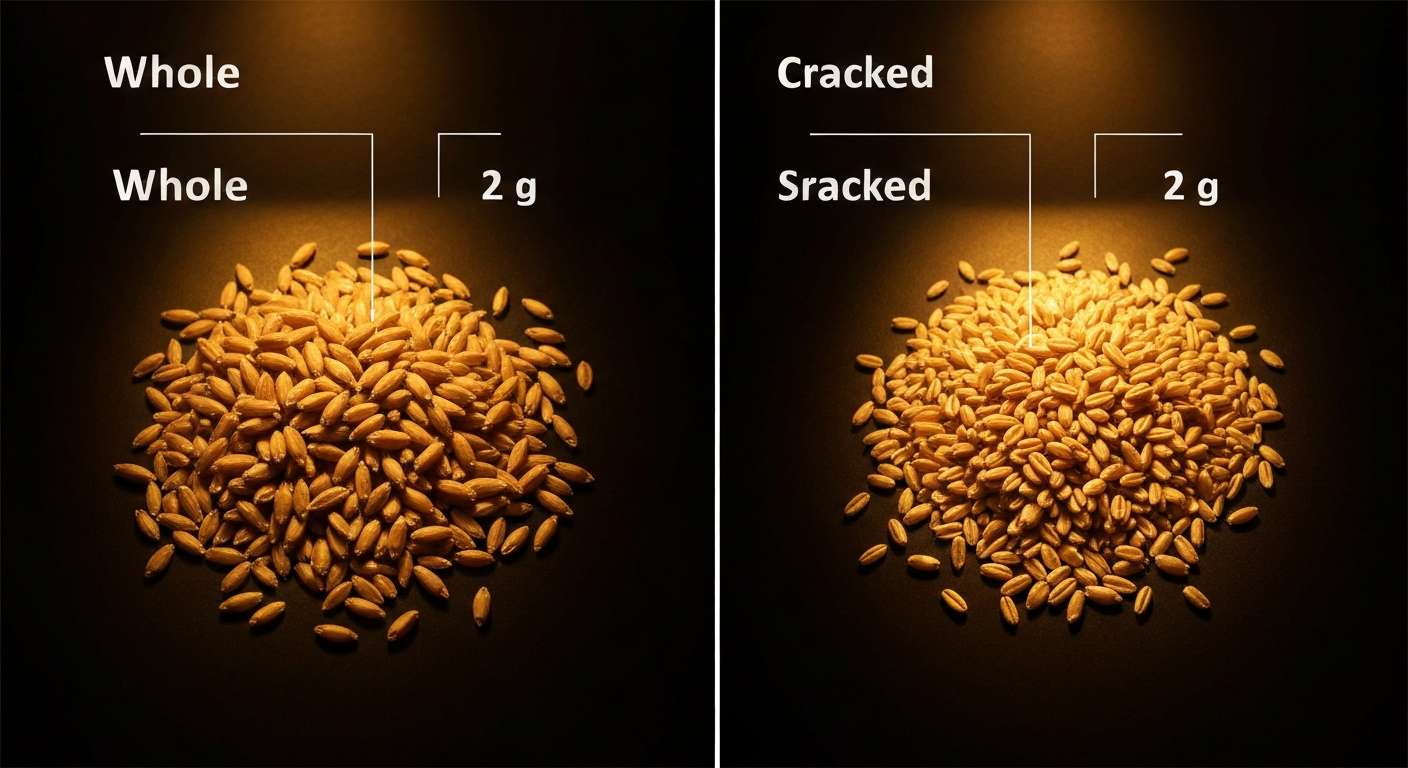
Rye's contamination rate is less than a quarter of oats and less than a third of WBS. Even against wheat. its closest competitor. rye contaminates at roughly half the rate. The reasons are structural: rye kernels have a tougher pericarp (outer shell) that holds up better during sterilisation without splitting open and exposing the starchy endosperm to bacterial colonisation. Wheat kernels are slightly softer and more prone to cracking, especially if hydration is even marginally over target. Oats are the worst offenders. the thin hull often separates entirely during sterilisation, leaving naked starch exposed.
I should note that my oats data is probably worse than average because I was still dialling in my oat hydration protocol during part of this period. An experienced oat grower might achieve 10-12% contamination rates. But that's still two to three times higher than rye. The structural advantage isn't something you can technique your way around entirely.
Yield: Does Grain Choice Affect Fruiting?
This is the question everyone asks and nobody has great data on, because there are so many confounding variables once you move from spawn to substrate. What I can tell you is what I've observed across approximately 200 fruiting blocks (supplemented hardwood sawdust) spawned with different grain types.
First Flush Yield. Pleurotus ostreatus (5 lb supplemented sawdust blocks)
Wheat spawn: avg 289g fresh weight (n=40, range 210-380g)
Oats spawn: avg 298g fresh weight (n=25, range 195-395g)
Milo spawn: avg 276g fresh weight (n=20, range 220-340g)
Biological efficiency: Rye 108%, Wheat 101%, Oats 103%, Milo 96%
Rye-spawned blocks consistently outperform, but I want to be careful about attributing this entirely to the grain. Rye spawn has more inoculation points per gram, which means faster and more even substrate colonisation, which means the block reaches fruiting conditions sooner and in better shape. It's an indirect advantage. the grain itself doesn't feed the mushroom during fruiting, but the head start matters.
When Rye Isn't the Best Choice
Right, here's the section I promised. Rye is not universally superior, and anyone who tells you otherwise is either selling rye grain or hasn't tested widely enough.
Jar-Based Workflows
If you're working exclusively with mason jars rather than bags, milo is genuinely competitive with rye. The round kernels pack more uniformly in a cylindrical container, and the tight packing actually improves kernel-to-kernel contact in jars (whereas in bags, rye's elongated shape creates better contact). I've seen jar growers get identical colonisation times with milo and rye. If you're in the US where milo is half the price of rye, it makes economic sense for jar work.
Budget-Constrained Beginners
If you're just starting out and you want to do five test bags to see if this hobby is for you, buying a 25 kg sack of rye is overkill. WBS from a pet shop. yes, the thing I've been criticising. will get you through your first experiments. The contamination rate will be higher, but you'll learn the process. Just don't draw conclusions about your technique from WBS results. Graduate to rye when you commit to the hobby. I wrote about sourcing quality rye grain in The Rye Bible if you're ready to make that switch.
Cordyceps militaris
This is the one species where rye is definitively not the best substrate. Cordyceps militaris performs markedly better on brown rice. the higher starch content and softer texture create conditions that this particular species thrives in. I've tested this directly: colonisation on brown rice was 30% faster and fruiting body formation was significantly more vigorous. If you're growing Cordyceps, use rice. Don't force rye because it works for everything else.
Agar-to-Grain Transfers with Very Small Amounts
When transferring from agar to grain using small wedges, milo and WBS can outperform rye simply because the smaller individual seed/kernel size means the agar wedge contacts more individual grains. This is a niche situation. most people are doing liquid culture to grain. but it's worth knowing if agar transfers are your primary inoculation method.
Don't Switch Grains Mid-Experiment
If you're comparing techniques, cultures, or additives, keep the grain constant. Switching grains introduces a variable that will confound every other measurement you're trying to make. Run your experiments on one grain, then if you want to test a different grain, that's a separate experiment entirely.
The Verdict
For the typical home cultivator running bags, working with common gourmet or medicinal species, and wanting a reliable, repeatable process: rye is the best grain substrate available. The colonisation speed is excellent (though not quite the fastest), the contamination resistance is unmatched, the yield advantage is real if modest, and the consistency is what really sets it apart.
The consistency point is the one I keep coming back to. Mushroom cultivation is a game of controlling variables. Every variable you can nail down. and grain choice is a big one. gives you more headroom to deal with the variables you can't control. When your grain is predictable, you can spot problems earlier. When a bag colonises slowly on rye, you know something's wrong because rye doesn't do that without a reason. When a bag colonises slowly on WBS, it might be a problem or it might just be Tuesday.
If you're ready to standardise on rye, start with Chapter 1 of The Rye Bible: Sourcing & Selecting, then work through the hydration protocol and sterilisation. The preparation method matters as much as the grain choice. rye prepared badly will underperform wheat prepared well. But rye prepared well? Nothing else comes close.
Track Your Own Data
My numbers are from my environment, my technique, my pressure cooker. Your results will differ in absolute terms but the relative rankings should hold. Keep a simple spreadsheet: grain type, date inoculated, date fully colonised, contamination yes/no. After 50 bags, you'll have enough data to make informed decisions for your specific setup.