Why Your Protocol Can't Stay the Same All Year
This is the article I wish someone had written for me three years ago. I spent my first full year of grain spawn production using exactly the same protocol in January as in July. same soak time, same simmer duration, same incubation setup. And I couldn't understand why my contamination rate spiked every summer and my colonisation slowed to a crawl every winter. I thought my technique was inconsistent. It wasn't. The weather was changing and my protocol wasn't changing with it.
The UK has genuinely challenging conditions for mushroom cultivation. We don't have the stable climate of a Californian garage or an air-conditioned American basement. We have damp, mild winters where ambient temperature hovers at 8-14°C and summers where a poorly insulated spare room can hit 30°C during a heatwave. We have autumn humidity that turns every surface into a mould incubator and spring cold snaps that can drop your incubation temperature by 10 degrees overnight.
Every one of these conditions affects your grain spawn. The soak rate changes with water temperature. The contamination pressure changes with ambient temperature and humidity. The incubation speed changes with room temperature. If you run a fixed protocol, you're optimising for one season and bodging the other three.
Summer Protocol (June-August)
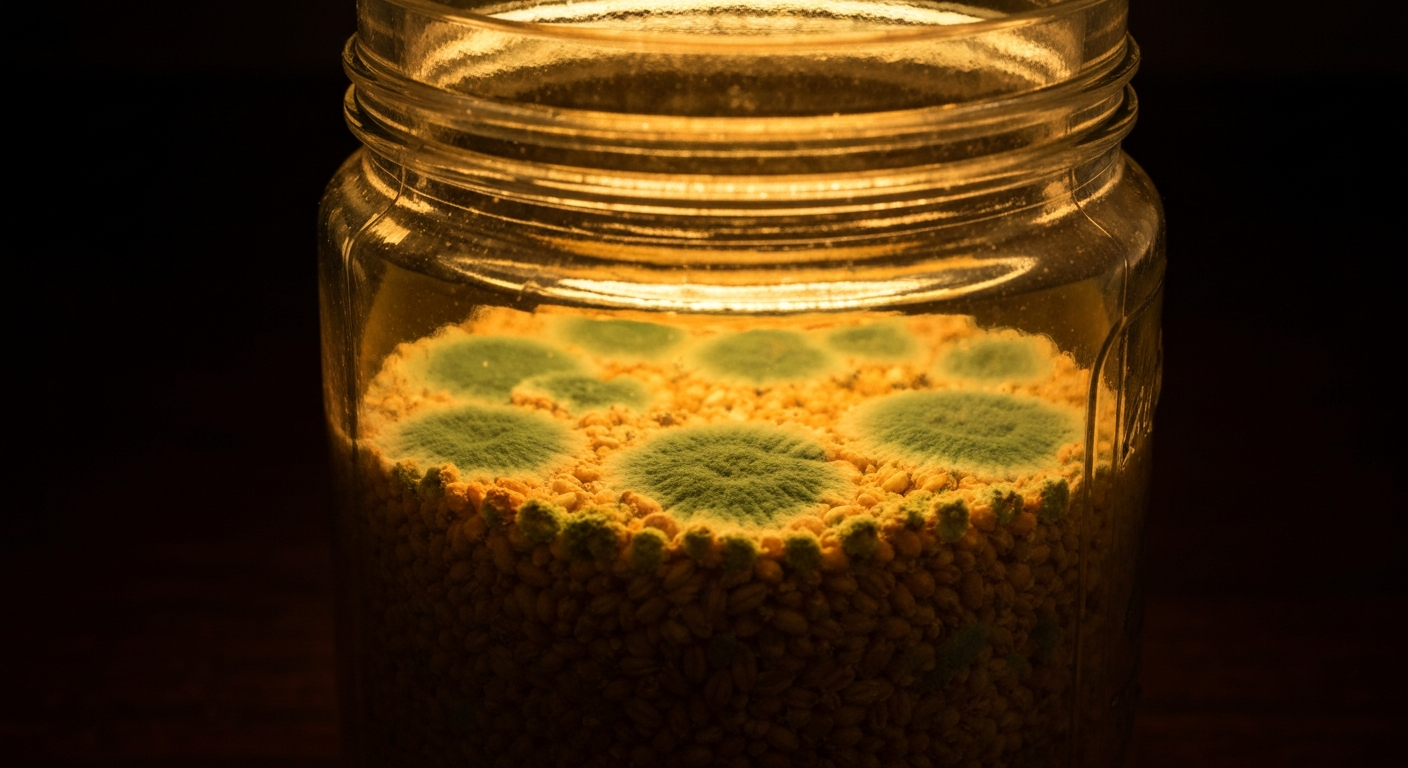
Summer is contamination season. Full stop. My 12-month contamination data shows a clear pattern: 2-3% contamination from November to March, 4-5% from April to May and September to October, and 8-12% from June to August. That summer spike isn't because I get sloppy when the sun comes out. It's because ambient temperature, humidity, and airborne microbial load all increase together, creating a perfect storm for bacterial and mould contamination.
Soak Time Adjustments
Water temperature from the cold tap in summer is typically 15-20°C in the UK. In winter, it's 5-10°C. That 10-degree difference significantly affects how fast rye grain absorbs water. A summer soak at 18°C reaches target hydration 3-5 hours faster than an identical winter soak at 7°C.
If you're following my standard hydration protocol (18-hour soak), you need to reduce that in summer. Over-soaked grain in warm water isn't just too wet. it's started fermenting. I've measured pH drops from 6.8 to 5.2 in grain soaked for 24 hours at 20°C. That acidification changes the bacterial ecology of the grain in ways that sterilisation can't fully reverse.
Summer Soak Adjustments
Tap water 18-22°C: Reduce soak to 12-14 hours
Tap water above 22°C (heatwave): Reduce soak to 10-12 hours, or soak in a cooler room
Always verify with the weight-based moisture test. the target is still 50-54% regardless of season.
Summer Sterilisation Notes
Sterilisation time doesn't change with seasons. 15 psi for 120 minutes is non-negotiable regardless of weather. But two things to watch for in summer:
- Faster cool-down. If your pressure cooker is in a cool room, fine. If it's in a warm kitchen after a July afternoon of cooking, the cool-down takes longer. Never force-cool a pressure cooker (cold water on the lid). the rapid pressure drop can burst bags.
- Load bags immediately after cooling. In winter, sterilised bags can sit on the counter for a few hours before inoculation without significant risk. In summer, every hour they sit exposed is an hour in warm, microbe-rich air. Inoculate within 2 hours of opening the cooker.
Summer Contamination Countermeasures
These are the extra steps I take from June to August that I don't bother with the rest of the year:
- Work early morning. I do all my inoculation work before 8 AM in summer, when the air is cooler and less turbulent. By midday, convection currents from warming surfaces are stirring up dust and spores.
- Extra SAB discipline. In winter, I can get away with minor shortcuts in my still-air box technique. In summer, I cannot. Every opening, every hand movement, every tool entry is a contamination opportunity that's amplified by higher microbial load.
- Shorter incubation checks. I check bags every 2 days in summer instead of every 3-4 days in winter. Early contamination detection means early removal before a contaminated bag can spread spores to its neighbours.
The Summer Batch Size Temptation
It's tempting to make larger batches in summer because colonisation is faster (warmer incubation temperatures). Resist this. Larger batches mean more bags at risk from a single contamination event. I actually reduce my batch size in summer. 12 bags instead of 16. so that if contamination hits, I lose less.
Winter Protocol (November-February)
Winter is slow-colonisation season. Contamination risk drops significantly (my winter contamination rate averages 2.5%), but colonisation times can double if your incubation temperature drops below 18°C. The challenge shifts from "keeping things clean" to "keeping things warm enough to grow."
Soak Time Adjustments
Cold tap water in a UK winter can be as low as 4-5°C. At that temperature, rye grain absorbs water very slowly. My standard 18-hour soak barely reaches target hydration in midwinter. You have two options:
- Extend the soak to 22-24 hours. This is what I do. The cold water temperature means fermentation isn't a significant risk even at 24 hours.
- Use warm water to start. Fill your soak vessel with water at 25-30°C. This kickstarts absorption and gets you to target hydration in the standard 18-hour window. The water will cool naturally, but the initial warm period accelerates early absorption. Some growers worry about bacterial growth in warm soak water. it's a valid concern if the water stays warm for extended periods, but since it cools to ambient within 3-4 hours, the risk is minimal.
Winter Soak Adjustments
Tap water 4-8°C: Extend soak to 22-24 hours, or start with warm water (25-30°C)
Below 4°C (hard frost): Use warm water start. Check hydration at 18 hours. may need full 24.
Again, always verify with the weight-based moisture test. The target doesn't change. only the time to get there.
Winter Incubation
This is the real winter challenge. Mycelium grows optimally at 24-26°C for most species. A UK spare room in January might be 12-16°C. At 14°C, colonisation that takes 12 days at 25°C will take 25-30 days. That extended colonisation window isn't just a patience problem. it's a contamination window problem. Even with winter's lower ambient microbial load, a bag that takes a month to colonise has twice the exposure time of one that takes two weeks.
Heating solutions (from cheapest to most effective):
- Reptile heat mat (£15-25): Place bags on a heat mat with a thermostat. Set to 24°C. Cheap, effective for 4-6 bags. The downside is uneven heating. the bottom of the bag is warm and the top is cooler, which can create moisture migration.
- Insulated incubation chamber (£30-50): A large plastic storage box with a heat mat inside and a thermostat controller. Line the inside with reflective insulation (the bubble-wrap foil stuff from B&Q). This creates a mini warm-room that holds 10-15 bags at a stable temperature. This is what I use and it works brilliantly.
- Dedicated warm room (£100+): A small room with a tube heater or oil-filled radiator on a thermostat. The most consistent option but only practical if you have a spare room or large cupboard you can dedicate to incubation.
The Airing Cupboard Trick
If your house has a traditional hot water cylinder with an airing cupboard, that's a free incubation chamber. The residual heat from the cylinder typically keeps the cupboard at 22-28°C year-round. I used my airing cupboard for my first two years before building a dedicated chamber. Just make sure the bags aren't touching the cylinder. direct contact can overheat one side of the bag.
Monthly Adjustment Chart
This is the chart I actually use. It's taped to the wall of my prep room and I update it each year based on actual performance data. The numbers below are calibrated for the English Midlands. if you're in Scotland, shift everything colder by about 2°C; if you're in the southeast, shift warmer by 1-2°C.
Monthly Protocol Adjustments (UK, Midlands)
February: Soak 22-24h | Simmer 20 min | Contam risk: LOW | Incubation: heated chamber essential | Avg colonisation: 17-20 days
March: Soak 20-22h | Simmer 20 min | Contam risk: LOW-MED | Incubation: heated chamber recommended | Avg colonisation: 15-18 days
April: Soak 18-20h | Simmer 20 min | Contam risk: MEDIUM | Incubation: ambient may suffice (check temp) | Avg colonisation: 13-16 days
May: Soak 16-18h | Simmer 20 min | Contam risk: MEDIUM | Incubation: ambient usually fine | Avg colonisation: 12-14 days
June: Soak 14-16h | Simmer 20 min | Contam risk: HIGH | Incubation: watch for overheating | Avg colonisation: 10-13 days
July: Soak 12-14h | Simmer 15 min | Contam risk: HIGH | Incubation: may need cooling | Avg colonisation: 10-12 days
August: Soak 12-14h | Simmer 15 min | Contam risk: HIGH | Incubation: may need cooling | Avg colonisation: 10-12 days
September: Soak 16-18h | Simmer 20 min | Contam risk: MED-HIGH | Incubation: ambient usually fine | Avg colonisation: 12-14 days
October: Soak 18-20h | Simmer 20 min | Contam risk: MEDIUM | Incubation: monitor. may need heat | Avg colonisation: 14-17 days
November: Soak 20-22h | Simmer 20 min | Contam risk: LOW | Incubation: heated chamber recommended | Avg colonisation: 16-20 days
December: Soak 22-24h | Simmer 20 min | Contam risk: LOW | Incubation: heated chamber essential | Avg colonisation: 18-22 days
Two notes on this chart. First, the simmer time drops to 15 minutes in July and August. This is because the grain hydrates faster in warm water and reaches target moisture with less simmering. Over-simmering already-hydrated grain leads to split kernels and mush. If your grain is at target weight after soaking in summer, you can reduce the simmer. it's there for final hydration and surface cleaning, not for reaching target moisture content.
Second, colonisation times assume a stable incubation temperature of 24-26°C. If you're incubating at ambient temperatures without heating, your winter colonisation times will be significantly longer than shown.
Contamination Patterns by Season
I've tracked contamination type (bacterial vs mould) alongside contamination rate, and the seasonal pattern is striking:
Contamination Type by Season (3-Year Dataset, 800+ bags)
Spring (Mar-May): 4.8% total contam | 55% bacterial, 45% mould
Summer (Jun-Aug): 9.4% total contam | 40% bacterial, 60% mould
Autumn (Sep-Oct): 5.1% total contam | 50% bacterial, 50% mould
Winter contamination is predominantly bacterial (often from insufficient hydration adjustments leading to extended colonisation times). Summer contamination is predominantly mould (Trichoderma, Penicillium, Aspergillus) from elevated airborne spore counts.
This data changed how I think about seasonal contamination. In winter, my enemy is bacteria. slow colonisation gives bacteria time to establish even in properly sterilised grain, especially if there are any micro-failures in the sterilisation process. The solution is better incubation temperature control to speed up colonisation.
In summer, my enemy is mould. specifically airborne mould spores that are vastly more abundant in warm, humid air. The solution is stricter sterile technique during inoculation and more frequent monitoring of incubating bags.
Seasonal Incubation Strategy
I run two distinct incubation setups depending on the season:
Winter Setup (November-March)
Insulated chamber with reptile heat mat and Inkbird ITC-308 thermostat controller set to 25°C. The chamber is a 60-litre Really Useful Box lined with 10mm foil-backed foam insulation. The heat mat goes on the bottom, covered by a wire rack so bags don't sit directly on it. The thermostat probe hangs in the centre of the chamber at bag height.
This setup holds 12-15 bags at a rock-steady 24-26°C regardless of whether the room is at 8°C or 18°C. Running cost is minimal. the heat mat draws 28W and the thermostat cycles it, so average consumption is about 10-15W. That's roughly 25p per day.
Summer Setup (June-August)
The insulated chamber comes out of storage, but this time the heat mat stays off. Instead, the chamber acts as thermal mass to buffer against daytime temperature spikes. Bags in an open room can hit 30°C+ during a July heatwave, which stresses the mycelium and promotes bacterial growth. Inside the insulated chamber, temperature swings are dampened. even without active cooling, the bags stay 3-5°C cooler than the room peak.
If ambient temperatures consistently exceed 28°C, I add a frozen water bottle to the chamber (replaced twice daily) to keep things below 26°C. Crude but effective. I've considered proper cooling solutions (Peltier cooler, mini fridge) but for 2-3 weeks of extreme heat per year in the UK, frozen water bottles are sufficient.
The Dangerous Transition Months
March-April and September-October are when I see the most inconsistency in my results. The weather is unpredictable. a week of 18°C sunshine followed by a 6°C cold snap in March, or late September warmth followed by an October frost. These swings catch people out because they've switched from their winter protocol to their summer protocol (or vice versa) and then the weather reverses.
My rule for transition months: check the 5-day weather forecast before starting a batch. If daytime temperatures are forecast above 15°C, use the spring/summer soak times. If below 12°C, use winter soak times. For incubation, keep the heated chamber running until you've had two consecutive weeks of ambient temperatures above 18°C in your incubation space.
The Thermometer You Actually Need
Forget the room thermometer on the wall. Buy a min/max thermometer (£8 from Amazon) and put it next to your incubating bags. What matters isn't the temperature at 2 PM. it's the minimum temperature at 3 AM. If your bags are dropping to 14°C overnight while hitting 24°C during the day, that thermal cycling slows colonisation significantly and stresses the mycelium. The min/max thermometer will tell you whether your incubation conditions are actually stable, not just occasionally warm enough.
Seasonal awareness separates growers who produce consistent results year-round from growers who have "good months" and "bad months." The protocol adjustments aren't complicated. shorter soaks in summer, longer soaks in winter, heated incubation in the cold months, contamination vigilance in the warm ones. But you have to actually make the adjustments. Stubbornly running the same protocol in February and July is like wearing the same clothes in both months. You can do it, but you'll be uncomfortable, and the results won't be great.
For the detailed base protocol that these seasonal adjustments modify, start with The Rye Bible: Hydration and Sterilisation. For troubleshooting contamination issues that might be seasonal, check the Troubleshooting chapter.